WALKING ON HALLOWED GROUND

Walking up hills and mountains, over quiet territories
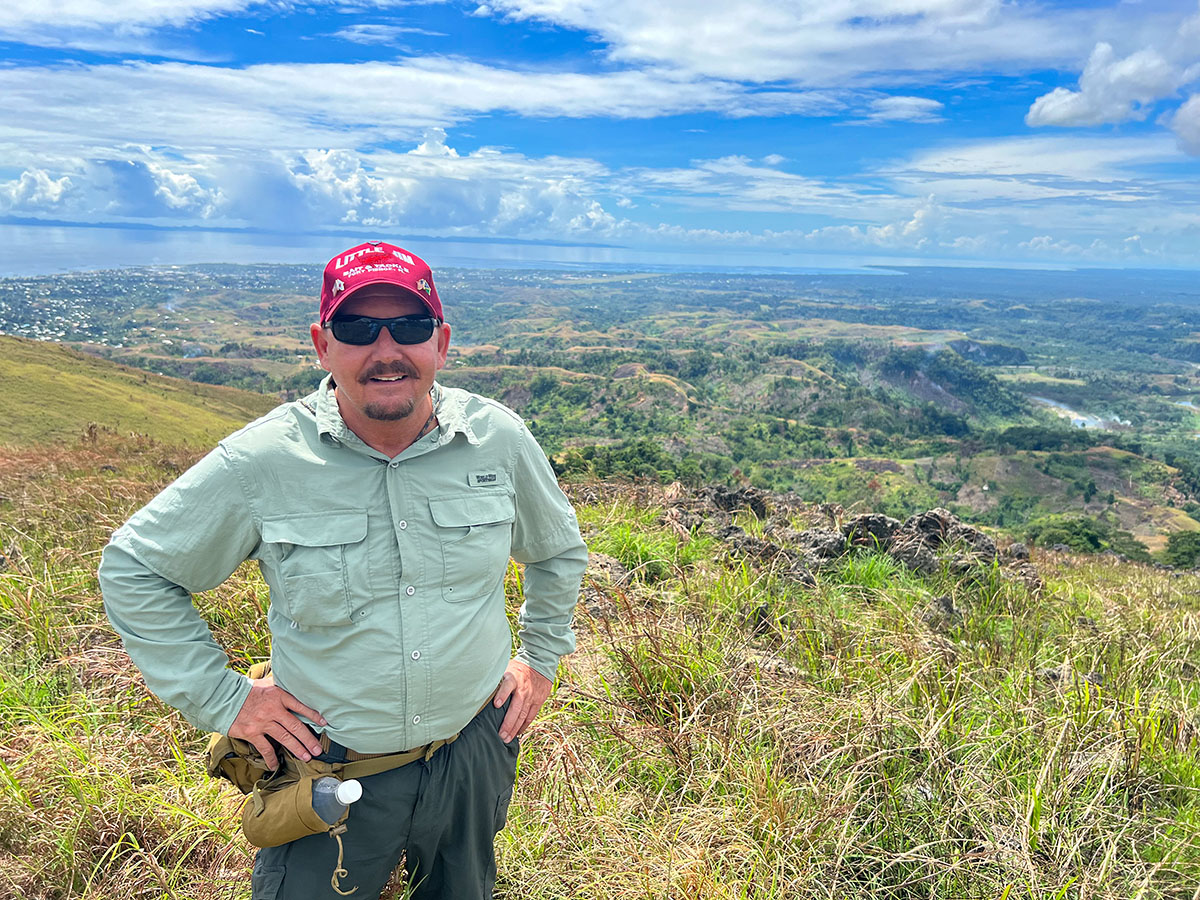
Walking up hills and mountains, over quiet territories that were once World War II battlefields, Fort Pierce resident Dana Beach saw firsthand the battle sites while visiting Guadalcanal and the Solomon Islands. Here, he stands at Mount Austin, where Japanese troops observed American soldiers. DANA BEACH PHOTOS

Veterans tour battlefields on Guadalcanal and other surrounding Solomon Islands

BY JERRY SHAW
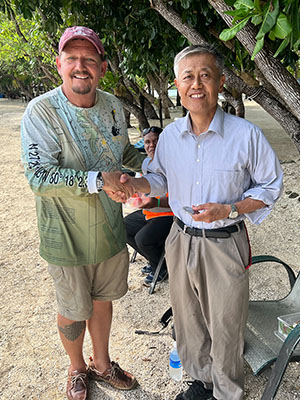
Beach greets Miwa Yoshiaki, Japan’s ambassador to the Solomon Islands
During a casual moment, Beach greets Miwa Yoshiaki, Japan’s ambassador to the Solomon Islands, who participated in the ceremony for the 80th anniversary of the battle. Representatives from both sides came to honor their dead.

Visiting the beautiful Solomon Islands is a pleasant vacation for many people, but for Fort Pierce resident Dana Beach, it was another walk through history.

Beach, a retired Air Force chief master sergeant who served with the pararescue unit and also retired from the St. Lucie County Fire District, has honored World War II veterans with the Liberty Jump Team [Indian River Holiday Issue, 2018], parachuting over battles in Europe, including jumps over Normandy for the 75th anniversary of D-Day.

The World War II aficionado and fellow jumpers decided to visit the Solomon Islands for the 80th anniversary of the battle in Guadalcanal, America’s first land war against Japan. The battle had raged from August 1942 to February 1943. 

Liberty Jump colleagues Scott Freund and Mike Sullivan joined him.

“We joined the Valor Tours. The rest were people we met, 16 people.”

Beach also visited other areas of the Solomon Islands, including islands where LTJG John F. Kennedy, the future president, and his PT-109 crew swam to after their boat was cut in half by a Japanese destroyer. PT boats were used to harass enemy destroyers bringing provisions to the Japanese during the Solomon Islands campaign of the Pacific theater.

“Guadalcanal was the first battle on the road to Tokyo,” mentioned Beach, who attended the anniversary ceremony at Guadalcanal, which included Marines, military officials and representatives from the U.S., Australia, New Zealand and Japan.

“It was kind of ironic we fought each other in World War Two and now we got together,” said Beach, who met the Japanese ambassador to the Solomon Islands. “At the ceremony there were a couple of hundred people.”

“The generals there were all two and three stars.”

Also in attendance was Caroline Kennedy Schlossberg, the U.S. ambassador to Australia and daughter of President Kennedy.

As she walked by him, Beach, a native of Worcester, Massachusetts, yelled to her, “Hey, I’m a Massachusetts guy.”

“That’s great,” she replied as she walked on. Her husband, Edwin, chuckled.

Beach was with a tour group during the first week. The second week he and friends did some freelancing on their own.

Visitors pose with Lt. Gen. Steven R. Rudder, commander of the Marines in the Pacific. Military officials and visitors honored past warriors of Guadalcanal with Dana Beach on the right.
Beach stands near a memorial to the Battle of Bloody Ridge when Marines fought to repel Japanese attacks.

TOURING BATTLEFIELDS

At Guadalcanal, they toured Henderson Field, the airfield built by the Japanese and captured by the Allies. Marines protected it in a grueling conflict for months. One of the hills surrounding the airfield was where the Battle of the Bloody Ridge took place as Marines repulsed Japanese attacks. They visited areas made famous through the James Jones novel and movie, The Thin Red Line.

“The local guide took us to battlefields. We saw artifacts still there.”

Artifacts he found on the various islands included everything from a military spam can, shrapnel, and a magazine clip to barbed wire from the perimeter of a battlefield, pieces of guns and a 5-gallon gas can with a USMC label.

Beach used his experiences with air rescue to conquer the challenge of climbing up mountains, including Mount Austin where the Japanese observed American activity at the time. “It took us a while to get up there.”

One of the places he and friends stayed was at Fatboys Resort on the island of Ghizo. It was within sight of Plum Pudding Island where Kennedy and crew swam to after their PT boat was destroyed. It is now nicknamed Kennedy Island.

“We had lunch on Kennedy Island. It was a great afternoon. The food was phenomenal,” Beach said. “We went to all three islands [Kennedy and crew swam to].”

The movie PT 109 shows the crew going to two islands, but in reality, three islands were involved. Kennedy swam to Nauru to find food while others stayed on the island of Olasana. Plum Pudding had no food or provisions for survival. Nauru is where Kennedy wrote his famous message on a coconut for help to be used by natives and taken to Australian coastwatchers. Kennedy and the rest of the crew on Olasana were later rescued.

“They were there for a week before they got picked up,” Beach noted.

“They were stranded on these islands in between battles. If they were caught, they would have had their heads cut off.”

“I couldn’t believe we were there, at Fatboys looking at Plum Pudding.” He also took soil samples from different islands as part of his World War II collection.

Local kids loved touring the islands with the visitors
Local kids loved touring the islands with the visitors, who gladly brought them candy and school supplies.
Beach and his friends took a day-long boat trip to Skull Island, where the U.S. Army fought the Japanese forces at Munda Point.
Beach jumped into the cockpit of a sunken Hellcat while diving, taking off his diving mask briefly for the photo.

UNDERWATER DIVING

The display honoring Coast Guardsman Douglas Munro stands near the spot where he died helping Marines land and evacuate on Guadalcanal. Munro is the only guardsman to be awarded the Medal of Honor.

Although an experienced parajumper, Beach changed his tune this time and took to underwater diving near the islands, where sunken craft still exist. While diving, he saw a sunken Japanese freighter [the Toa Maru], a Japanese fighter plane and an American Hellcat fighter.

“I sat in the cockpit of the Hellcat,” he said. He took off his mask to have a photo taken in the craft.

Unlike the war years, the people on the islands were very open and friendly. At the island of Tulagi, where another brutal battle in the Pacific campaign had been fought, the chief of police drove to get them a six-pack.

They met a lot of locals on the island of Ghizo, near where Kennedy’s PT boat sank, and they bought Tootsie Pops for kids. “I bought three and a half pounds, and they loved it,” Beach said.

“Kids followed us everywhere. They were barefoot and we wore boots. They were laughing like it was no big deal.”

They also brought school supplies and reading materials for the children.

“I gave a Navy SEAL-UDT shirt [from the National Navy-UDT SEAL Museum in Fort Pierce] to one of the locals.”

On the whole on the Solomon Islands, he said, “The people were the nicest people.”

They took an all-day boat trip to Skull Island, where the battle of Munda Point between the Army and Japanese took place. There, they visited a private museum that contained World War II equipment, hand grenades, Japanese weapons and helmets. “That was a wonderful trip.”

Perhaps his most cherished memory was at the U.S. memorial at Guadalcanal. The Marines spent a great deal of time at Guadalcanal, but the Navy also helped.

“I made a wreath to honor sailors from ships that sunk. They don’t get the recognition.”

See original article in print publication

Dec. 22, 2023

Please follow and like us: