
UNCONQUERED

A young Seminole woman’s defiance in 1858 helped ensure her people’s survival in Florida — and shaped generations to come
BY GREGORY ENNS
History almost lost her. Florida didn’t.
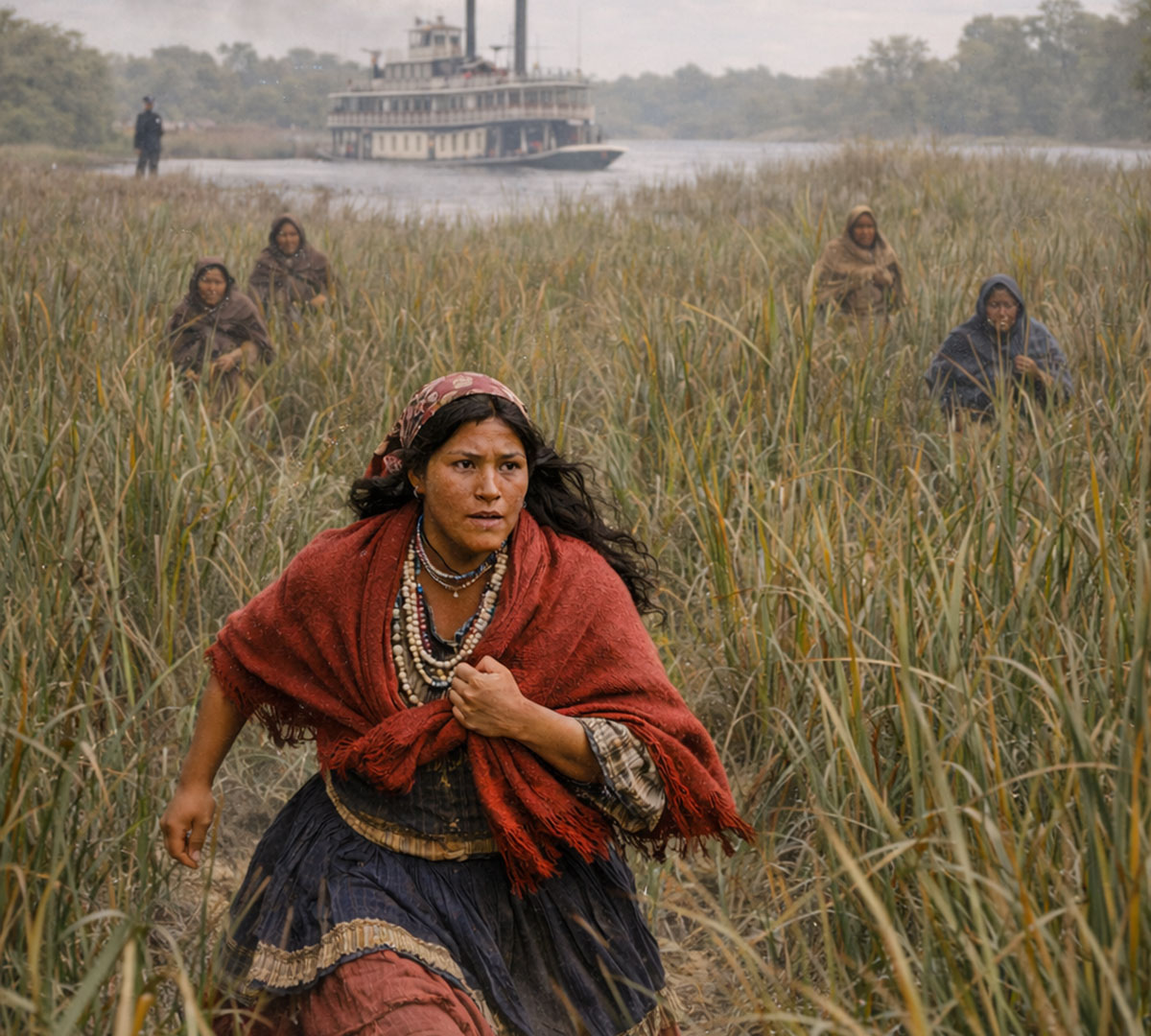
In 1858, as the final Seminoles were being forced out at the end of the Third Seminole War, a young woman named Emateloye — later known as Polly Parker — stepped off a military steamer under the pretense of gathering medicine and disappeared into the woods.
She didn’t flee alone. With five other women, she led a grueling 350-mile journey on foot, navigating wilderness and danger to return to the swamps around Lake Okeechobee. It was an act of defiance, one that helped ensure the Seminole would survive in Florida.

Today, her name is largely forgotten outside the Seminole Tribe. Yet Polly Parker’s escape helped shape what followed: the survival and persistence of a people the U.S. government had spent decades trying to remove.
When forced deportations finally ended in 1858, Army officials estimated that fewer than 200 Seminoles remained in Florida, though the Seminole Tribe puts the number closer to 500. Those who remained had mostly taken refuge in the Everglades, a vast marsh system stretching south to Florida Bay.
Polly spent her later years on the Treasure Coast, near a small stream known as Cow Creek. Her open-sided chickee, topped with a thatched roof, likely stood in a hammock on what is now Adams Ranch, west of Fort Pierce. There, she became a matriarch who helped rebuild a population that had nearly vanished. Today, the Seminole Tribe of Florida numbers about 4,000 members: a legacy shaped in part by her perseverance.
A CHALLENGING SUBJECT
Perhaps no Seminole figure is more misunderstood — or more overlooked — than Polly Parker. Because U.S. Army reports and newspaper accounts of the time focused largely on male warriors, little biographical information survives about Polly, who lacks even the recognition afforded to Native American women such as Sacagawea.
Yet her significance to her people is just as profound, and her acts of defiance perhaps even greater.

Reconstructing Polly’s life presents familiar challenges in Native American history. The record relies heavily on more abundant, but often biased, military accounts, while Seminole oral traditions, though vital, are less frequently recorded or publicly accessible. Complicating matters further, Polly did not acquire the English surname “Parker” until at least a decade after her escape from the steamer Gray Cloud, when her husband adopted the name of a white settler, Henry Parker.
Author James W. Covington, in his Seminoles of Florida published in 1993, identified a Seminole woman named Polly as “working as a scout for the Army,” though whether this woman was Polly Parker is dubious.
In those accounts, Polly and her husband, Chai, were pressed into service during the Second Seminole War as scouts conducting patrols in the Everglades. Their role was to help Army forces locate Seminoles and facilitate their forced removal west of the Mississippi, under President Andrew Jackson’s Indian removal policy. Instead, Polly misdirected the soldiers, leading them on fruitless searches through the vast wetlands.
According to these accounts, Polly and Chai lived as outcasts after the Second Seminole War ended in 1842, settling near present-day Bradenton. She was pressed into service again in the Third Seminole War by Capt. Jacob E. Mickler.
A woman named Polly also appears in the written records of Capt. Abner Doubleday — a future Civil War general — who is often, though incorrectly, credited as the inventor of baseball. In his writings, Doubleday described working with Polly in 1857 as he searched for Seminoles on islands in Florida Bay. “I do not believe she ever found any Indians for us or intended to find them,” Doubleday wrote. “She kept out of their way and did what she could to prevent our troops from meeting them.”
For a time, some historians believed these references pointed to the same woman who would later escape from the Gray Cloud. The theory gained momentum in 2013, during media coverage of the tribe’s reenactment of the steamer’s journey.
Willard Steele, former preservation officer for the Seminole Tribe, once subscribed to the theory that the Polly in the earlier accounts was Polly Parker, but he later withdrew that conclusion following additional research. The tribe’s historical accounts also do not identify Polly Parker as the scout described in military records.
Geneva Shore, Polly Parker’s great-great-granddaughter, also rejects the claim that Polly was a scout for the Army. Before Polly’s capture, Shore said, “she was just running, trying to get away and raising her family.”
EARLY LIFE
Much of what is known about Polly Parker’s early life is rooted in Seminole oral tradition collected by amateur historian Albert DeVane, who interviewed members of her family on the Brighton Reservation from the 1930s to the 1960s. According to those accounts, Polly was the daughter of Catcha Hadjo, a leader within the band of chief Echo Emathla Chupco.
Chupco was born around 1805, a member of the Upper Creek faction known as the Red Sticks, from the town of Tallassee on Alabama’s Tallapoosa River. This group defined itself by its resistance to U.S. expansion and its commitment to traditional Creek culture. After their defeat by Andrew Jackson at the Battle of Horseshoe Bend in 1814, many Red Sticks fled into Florida, where they became part of what would later be known as the Seminoles.
Another Red Stick from the Tallapoosa region was the most famous Seminole of all, Osceola, whose life intersected with Chupco’s Red Stick faction.
Chupco’s band — sometimes called the “Tallahassees,” a name tied to their Alabama origins rather than the Florida capital — moved through north and central Florida as they were pushed south by conflict. In 1818, during the First Seminole War, Chupco’s father was killed near the Suwannee River in northern Florida, where the band had been living after fleeing Alabama. The attack came as Gen. Andrew Jackson’s forces destroyed Seminole settlements in the area.
Afterwards, the band moved south to the Peace River area, near present-day Bartow, and by around 1823 they had resettled near Thonotosassa Lake near present-day Tampa, where they lived through the 1820s and into the 1830s. It’s likely there that Polly was born in a Seminole village in the year 1826 or 1828, depending on which census is cited.
Like many Seminole leaders, Chupco spent years in armed resistance. He was present during the Second Seminole War, where he took part in the Dade Massacre and other attacks, including killing a sentry at Fort Cummings near Lake Alfred. He was also involved in raids and violent incidents in the late 1840s and early 1850s, often associated with resistance fighters like Sam Jones and Billy Bowlegs. As U.S. pressure intensified, his band was pushed steadily south, retreating into the peninsula’s interior and eventually into the Lake Okeechobee region, the Kissimmee Valley and the Everglades.
Chupco lived through and fought across all three Seminole Wars — the First [1817–1818], the Second [1835–1842] and the Third [1855–1858]. While the U.S. government treated them as separate conflicts, the Seminoles experienced them as a single, continuous 41-year struggle against removal.
By 1858, after decades of conflict, most Seminoles agreed to removal west under financial incentives negotiated with chief Billy Bowlegs and his Miccosukee band.
According to those terms, Bowlegs and his followers would be transported to a Seminole reservation west of Fort Smith, Arkansas. Payments were offered as incentives: $1,000 to sub-chiefs, $500 to warriors, and $100 to women and children. Bowlegs would receive $6,500. In all, Bowlegs’ party included about 125 Mikasuki-speaking Seminoles: 38 men and roughly 85 women and children, including two of his wives.
But not all Seminoles complied. A small band led by Abiaka, known as Sam Jones, refused removal outright. Elderly, blind and said to be more than 100 years old, Jones declared that “two wagon loads of money” would not persuade him to leave Florida. His group — about 17 warriors and their families — remained in hiding in the Everglades.
Also outside Bowlegs’ agreement were Muskogee-speaking Cow Creek Seminoles, including the woman who would become known to history as Polly Parker.
THE ESCAPE NARRATIVE

Albert DeVane’s account of Polly Parker’s escape first reached a wider audience in a 1956 Tampa Tribune column by D.B. MacKay. Drawing on interviews with Polly’s daughter, Lucy Tiger, DeVane compiled a narrative and sent it to MacKay with permission to publish it “any way you wish.”
DeVane said he first heard Polly’s story about two decades earlier and later developed it into a fuller account. The narrative was eventually included in DeVane’s Florida History, Part 1. A copy of the original document is on file at the Seminole Ah-Tah-Thi-Ki Museum at Big Cypress.
“She was known by many early pioneers from the City of Kissimmee to Fort Pierce,” DeVane wrote of Polly. “She was a very kind and humble Indian and was much loved by her white friends and her band.”
According to DeVane, Polly and 38 other Cow Creek Seminoles were captured after refusing to surrender under deportation terms. Florida militia under Gen. William Harney, based at Fort Brooke in present-day Tampa, pursued them across Central and South Florida — from the lower Kissimmee River and Lake Istokpoga to Fisheating Creek and the cypress swamps of present-day St. Lucie and Martin counties.
Militia members were paid for their captures: $500 for a warrior, $250 for a woman and $100 for a child. Most of those taken were women, as many men remained hidden deep in the Everglades.
Lucy Tiger later recalled her mother being captured in what was known as the “Parker Island territory,” likely an island in Lake Istokpoga near present-day Lake Placid. From there, Polly and the others were transported by ox cart to Fort Brooke.
From Fort Brooke, Polly was taken about 35 miles by boat to Egmont Key at the mouth of Tampa Bay, where she was imprisoned under armed guard. A depot for the removal of Seminoles, Egmont Key has been remembered by tribal members as “the dark place,” “our Alcatraz,” or simply a concentration camp.
Polly and the others were held in a stockade until the arrival of the Gray Cloud, a civilian sidewheel steamer under military contract to transport Seminoles to New Orleans. From there, they would board another vessel up the Mississippi and Arkansas rivers to Fort Smith, Arkansas, then walk 100 to 200 miles to assigned lands in Indian Territory.
While Polly’s band was confined on Egmont Key — an island whose isolation discouraged escape — Billy Bowlegs’ Miccosukee band camped at Fort Myers, free to come and go after agreeing to depart voluntarily.
Newspapers of the day reported that Bowlegs and his followers boarded the Gray Cloud at Fort Myers on May 4, 1858, with payment issued as they embarked, according to Adjutant Gen. Maj. F.N. Page.
Two days later, on May 6, the vessel reached Egmont Key, escorted by the steamer Ranger. There, Bowlegs’ party was joined by the 39 Cow Creek captives, including Polly, bringing the total aboard to roughly 165 — the figure most consistently reported in contemporary newspapers.
The numbers, however, do not fully align. Bowlegs’ group is often listed as 123 to 125 people, while Cow Creek estimates ranged from 35 to 40.
While all aboard were considered Seminoles, they differed in both outlook and language. Bowlegs’ Miccosukees had agreed to emigrate; the Cow Creeks had not. They were also divided by language: the Cow Creeks spoke Muskogee, while Bowlegs’ band spoke Hitchiti.
According to DeVane’s account, the steamer stopped at St. Marks, southeast of Tallahassee, to take on wood. There, Polly seized an opportunity. Claiming some of her people were ill, she persuaded the officer in charge to allow a group of 12 to go ashore to gather medicinal roots.
Once in the woods along the St. Marks River, the group scattered at a signal and fled into the swamp. About six were recaptured, but roughly five others — including Polly — escaped. “Their only thoughts and hopes were of a chance to escape and return to their homeland,” DeVane wrote.
In a 1968 interview with Lucy Tiger, Miami Herald reporter Nixon Smiley reported that the escapees included Polly’s mother and sister, another Seminole named Pahee and at least one male warrior.
The night of the escape, guided by owl-call signals, the survivors regrouped and began a determined journey south. As they continued their journey, traveling mostly at night, they survived on berries until they were able to catch fish and cook their first proper meal since escaping.
After days of hardship, they reached the Lake Okeechobee region, where they recovered a cooking pot from an old camp and found a hidden canoe. They continued south into the Everglades until arriving in their homeland. “Upon their arrival there was great reunion of joy with her husband Hene-Le-Maaas-La and other people who had escaped capture,” DeVane wrote.
While the DeVane account indicates that Polly’s relationship to Henry Parker dated back to at least 1858, neither would have used the English name Parker until at least 1870. That’s when the white settler Henry Parker arrived in the Kissimmee River Valley. It was sometimes the custom for Seminole adults to use the name of a white settler they admired for their English name. That was the case with Hene-Le-Maaas-La, who adopted the name Henry Parker for himself.
FOR THE RECORD
It is unclear how long the escape and subsequent search may have delayed the Gray Cloud at St. Marks. Though numbers in newspapers varied, Army correspondence consistently reported 165 Seminoles aboard the vessel when it departed Egmont Key on May 6 and again on May 13, when Elias Rector telegraphed from the Head of Passes — about 100 miles southeast of New Orleans — stating, “I am here with Billy Bowlegs and 165 Florida Seminoles, on board U.S. Steamer Gray Cloud.”
The steamer reached New Orleans on May 15, and the Seminoles were transferred days later to the steamer Quapaw for transport to Fort Smith, arriving May 26, before continuing overland to their assigned lands.
Back in Florida, officials moved quickly to close the final chapter of the Seminole Wars — one of the longest and costliest series of Indian conflicts in U.S. history. With Bowlegs removed, Col. Gustavus A. Loomis declared the war finished, assuring residents they could return “without fear of further molestation.”
Yet the public record is notably silent on any escape. Contemporary newspapers published detailed accounts of the voyage and a manifest listing 134 of the 165 Seminoles aboard, including two women named Polly, but made no mention of resistance or escape. Likewise, no known Army or Bureau of Indian Affairs correspondence acknowledges such an incident, and official reports maintained a consistent headcount throughout the journey.
That silence may not have been accidental. In May 1858, federal authorities were under clear pressure to bring the long and costly Seminole conflict to a close, both politically and militarily. Declaring the end of the war required a narrative of finality — one in which resistance had effectively ended, and the remaining Seminoles had been successfully removed.
Any report of escape, resistance or disorder during the Gray Cloud voyage would have complicated that narrative, suggesting that control was not as complete as officials claimed. In that context, the absence of any mention in Army or Bureau of Indian Affairs correspondence, along with the consistent reporting of headcounts, raises the possibility that such incidents were deliberately omitted or minimized. By maintaining a clean, uninterrupted account of removal, officials could more convincingly present the war as concluded and reassure the public that Florida was secure.
UNCONQUERED PEOPLE
It was not until nearly a century later, in 1956, that a different version of events emerged. Whatever happened aboard the Gray Cloud, the broader outcome is clear: The 1858 removal marked one of the final forced migrations of Native people. Their ordeal is often associated with the wider Trail of Tears era — the mass displacement of Native nations from about 1830 to 1850 — though it occurred during the closing years of the Third Seminole War, nearly a decade later.
But it did not end the Seminole presence in Florida.
Those who refused to leave — hiding in the Everglades and Big Cypress — endured and rebuilt, never formally surrendering and often described as the only Native people not to sign a formal peace treaty with the United States. Their descendants later formed the Seminole Tribe of Florida, which today identifies itself as “the unconquered people,” and the Miccosukee Tribe of Indians of Florida, which was recognized as a separate tribe in 1962.
Polly’s escape secured her place in history as a symbol of Seminole independence, courage, defiance and devotion to her homeland; and as the Seminole Tribe’s Evangeline — a reference to the fictional character in the Longfellow poem who endured exile from Canada to Louisiana.
And while details of Polly’s escape did not become public until nearly a century later, references in the late 19th and early 20th century suggest she held a position of prominence, with one newspaper in the 1890s referring to the “Polly Parker band’’ of Seminoles.
A DARK TIME
As the Civil War approached in 1861, the federal government’s attention to the Seminoles and removal waned. By then, any effort to pursue a noncombatant fugitive such as Polly had all but disappeared. A fragile detente took hold: The Seminoles remained out of sight, hidden deep in the Everglades and the backwoods of Central Florida, with little contact with white settlers.
For this reason, relatively little is recorded about the Seminoles between 1858 and 1880. Army officers were no longer documenting their movements or encounters — records that had previously formed the backbone of Euro-American understanding of Seminole life.
That changed in late 1880 and early 1881, when the Smithsonian Institution commissioned a Unitarian minister, Clay MacCauley, to survey the Seminoles. He identified five Seminole settlements: Big Cypress, Fisheating Creek, Miami, Catfish Lake and Cow Creek, a small, cypress-shrouded waterway along the present-day border of St. Lucie and Okeechobee counties.
MacCauley noted that residents of Catfish Lake, Fisheating Creek and Cow Creek spoke Muskogee, while those at Big Cypress and Miami spoke Mikasuki. In The Seminole Indians of Florida, published in 1889, he estimated the 1881 Seminole population as 208.
“Shortly after this date, the Muskogee-speaking Catfish Lake and Fisheating Creek settlements consolidated with those at Cow Creek, constituting the Cow Creek band,” historian Mark Boyd later wrote.
MacCauley’s map pinpointed the location of Cow Creek, and his work is generally considered the first published reference to the Cow Creek Seminoles, by that name. Previously, they had been known as “Tallahassees,” a corruption of Tallassee, the Alabama town from which many Muskogee speakers originated.
No longer pursued after the Third Seminole War, Florida’s Seminoles began to settle in more permanent locations. They lived independently and apart from white settlements, hunting game and tending small gardens, their communities organized around clan structures and matriarchal leadership.
But as the decades passed, cattle ranching expanded and barbed wire fences spread across the landscape, cutting off traditional hunting grounds. Increasingly, Seminoles turned to nearby settlements to trade for food and supplies. Polly Parker was among the first to make that transition.
POST-WAR POLLY
Beginning in the 1880s, white settlers in Fort Pierce began reporting their encounters with Polly. The community had the Hogg and later Cobb trading posts, which commonly traded with the Seminoles. While visiting the posts, the Seminoles would camp along Moore’s Creek, the tiny waterway that flows into the Indian River near what is now the Manatee Observation and Education Center.
The early visits to Fort Pierce foreshadowed what would become a weekly ritual through much of the first half of the 20th century, with Cow Creek Seminoles coming into town on Saturday afternoons to trade items such as huckleberries, produce, clothing and other goods.
Pioneer Emily Lagow Bell recalled her encounters with Polly Parker in a memoir of her early years in St. Lucie County from 1876 to 1898. She wrote that she first met Polly in 1882, when Polly and a group of Seminoles — including her daughter, Lucy Tiger, three children, and a Black woman named Nance, the wife of Tuscanuga — were in Fort Pierce.
Bell said she was making syrup cookies at her home on the Indian River and gave them to Polly, thinking she would pass them around to the others. “Old Polly took her dress up and poured the whole batch of them in her dress, so the rest of them wouldn’t get any.’’ Upset, Bell summoned her husband. “He made Polly give some to all of them. She didn’t like it.” In the anecdote, Bell may not have understood Polly’s role as clan matriarch, responsible for controlling and distributing resources.
Bell recalled another encounter when her mother was fixing a dinner for men staying at her boarding house in Edgartown. She had cooked swamp cabbage, turkey and deer meat. “Mother knew the Indians would be in that night,’’ she wrote. “Sure enough, there was Henry Parker, Johnny Doctor, and Polly and Lucy at the door early.’’
Mary Summerlin, who reported her interactions with the Cow Creek Seminoles in a series published in the Fort Pierce News-Tribune in 1936, recalled first encountering Polly Parker in 1895 while Summerlin was a teacher in St. Lucie, now known as St. Lucie Village, just north of Fort Pierce. In her writings Summerlin noted that Polly had deer skins curing at her camp and was traveling with burlap sacks — details suggesting her visits into town were likely for trade.
Wrote Summerlin:
While teaching school at St. Lucie, Old Polly Parker [Chief Parker’s squaw] came riding in over the hills on a lean pony, bareback, astride with only a saddlebag of croker sacks slung across the pony’s back. She dismounted at Ned Summerlin’s gate and was welcomed very cordially by the whole family, invited to sit at our table and was led to talk by Mr. Summerlin, who was liked and trusted by the Seminoles. She told us her people were camped just over the hills, back of St. Lucie for a little while, and invited us to visit them, so in a few days the horse was hitched to the wagon and we returned her visit — my first and last to an Indian camp for almost 30 years.
Summerlin did not say precisely where Parker’s camp was.
The camp struck me as very crude and not very clean. I don’t remember details, except that they had a deerskin stretched under the trees about five or six feet from the ground, not yet cured and in it strips of venison were drying along with the skin. Aunt Polly very happily gave us bundles of dry skins to sit on and very patiently taught me many Indian words. I wrote them down as they sounded and had quite a vocabulary.
Given the directions and distances mentioned, Cow Creek, some 17 miles from Fort Pierce, could have been the location for Polly and Henry Parker’s camp.
Henry Parker died in 1899, with the Dec. 13 edition of the St. Augustine Record reporting: “Henry Parker, a well-known Seminole Indian, recently died at Indian Town, about 80 miles west of Jupiter. He was a very peaceful Indian; and, like poor old Tom Tiger Tail, who was killed by lightning in September, was much respected by white people — especially by hunters.’’
THE PHOTO
Polly had become well-enough known in Fort Pierce that in early 1909 photographer Harry E. Hill had her sit for a portrait at his Florida Photographic Concern studio on Pine Street, now Second Street. Hill — who also published a periodical called the American Beekeeper — founded the photographic concern in 1900. Today, the studio still stands, converted into a bar called Pierced Ciderworks.
Hill recorded the photo, No. 839, in his logbook, naming it “Aunt Polly,” the same reference Summerlin had made: a sign of the high regard settlers had for her. The photo was apparently one of Hill’s favorites, as a 1910-era photo of Hill in his studio shows him sitting at a desk against a wall of his most iconic photographs, including the one of Parker.
Hill’s portrait is the only photo of Polly known to exist or publicly circulate. Patsy West, director of the Seminole/Miccosukee Photographic Archive, said Polly’s dress in the photo is of patterned cotton broadcloth, perhaps purchased locally at a store or trading post, likely from funds earned from the sale of hogs raised by the Seminole women.
Polly’s simple banded dress was made at a time of transition for Seminole women’s clothing: from handmade work with single color fabrics to dresses of multiple colors made with sewing machines that could more easily produce geometric designs. Seminole women began using hand- and foot-cranked sewing machines in the 1890s. As the use of sewing machines became more widespread in the 20th century, their patchworks became much more prevalent and elaborate.
The many beads around Polly’s neck in Hill’s photo don’t signify status, West said. Shore said the number of beads worn wasn’t unusual for the time. “They used to wear even more than that,” she said.
Perhaps the most striking part of the photo is a safety pin prominently fastened to her dress, an ornament Hill either missed or decided to keep in his portrait instead of having Polly remove it.
Cow Creek is about 5 miles closer to Okeechobee than Fort Pierce, so Polly also was a frequent visitor to what became downtown Okeechobee — particularly Meserve Hardware, owned by Faith Meserve, daughter of Okeechobee founder Peter Raulerson, and her husband, Ellis. Faith Meserve liked Polly so much that she hung Hill’s portrait of her in the store, where it was displayed for decades. “Meserve always enjoyed the old woman’s presence in the store and, even though she spoke no English, she was always smiling and nodding,” historian Harry Kersey wrote.
Polly’s comfort among white settlers in later years marked a sharp contrast to her earlier experiences. “[Lottie] did say that when Polly was always scared of white people and used to run from them during the war,’’ Shore said. “But later, she said she had a lot of white friends she used to go and visit.’’
In 1899, the Friends of the Florida Seminoles organization took up Polly’s cause, buying an 80-acre tract in what is now St. Lucie County, according to Kersey. But the land, referred to as Polly’s Camp, was lost in 1926 for failure to pay property taxes when pioneer J. G. Coats brought suit to quiet title after paying the delinquent taxes.
FESTIVAL CELEBRITY
Newspaper accounts of Polly don’t surface again until the spring of 1922, when she became a central attraction at a festival planned in West Palm Beach. The celebration, called the Sun Dance Festival, was intended to promote tourism by showcasing Seminole culture.
The Miami Metropolis, quoting promoter A.V. Brown, reported that Polly “has promised to come in from Cow Creek to take part in the Seminole Sun Dance” and would lead the Seminoles in a parade. In the days before the festival, the Tampa Morning Tribune wrote that a festival official was in the Everglades encouraging members of the Cow Creek and Big Cypress bands to attend.
In a follow-up story, the Tampa Morning Tribune reported that Polly had indeed attended the festival: “Aunt Polly Parker, reputed to be 100 years of age and the oldest Seminole living, is here and posed freely today for her picture.” Despite this claim, and although a notice was carried on the wires, no photograph appeared in any newspapers, raising doubts about the report.
Polly died in the summer of 1922, just four months after her reported appearance at the Sun Dance. The Sebring White Way was one of the few newspapers that covered her death that summer, saying that word has been passed along by Mose Lanier of Basinger. “Up to a few days of her death she was said to be very bright and her memory exceedingly keen, and she used to tell of things that happened almost from the beginning of the United States,” the Sebring newspaper reported. “Until a few years ago she was a most active woman, and after passing her century mark was doing the work around camp that the women do with as much ease as a woman of half her age.”
POLLY’S BURIAL
Albert DeVane’s brother, Parke, wrote in his memoirs that in July 1959, Seminole leader Billy Bowlegs III guided him and Albert to a site off State Road 70 near the Kissimmee River that he identified as Polly Parker’s burial place.
“While traveling east on Route 70 from Brighton, about three miles before you come to the Kissimmee River, Billy said, ‘Stop,’” Parke DeVane wrote. “He pointed north to a small cabbage hammock and said, ‘Polly Parker buried there.’”
The men did not visit the hammock that day because it was on private property but later obtained permission from the landowner. Parke DeVane described it as “a beautiful place with many very large live oaks and cabbage palms,” estimating it covered about five acres.
While exploring the site, the brothers found fragments of broken ceramic pottery and believed it marked Polly’s final resting place, though no formal grave marker was present.
Geneva Shore said Polly had expressed a desire to be buried under oaks near the Kissimmee River. “That’s where she grew up,’’ she said. She noted the hammock was once visible from present-day State Road 70, just west of the Kissimmee River crossing. The location, shaded by oaks and near water, aligns with those wishes.
According to Shore, Polly fell ill in the spring or early summer of 1922 at her camp along Cow Creek. Around that time, Seminole families were preparing for the Green Corn Dance, an annual ceremony, then held near present-day Brighton.
Recognizing Polly was gravely ill, relatives traveled with her by wagon, perhaps pulled by an ox, some 30 miles west to the gathering in Brighton. Census records show eight Seminole families living along Cow Creek in 1920, many of them Polly’s descendants, making it likely that most of the community took part in the journey.
During the trip, a wheel on the wagon broke. Shore said her mother, Lottie, and her aunt, Hattie, were sent ahead to Brighton for help. The wagon was eventually repaired, and Polly was brought to the gathering. Polly and family members stayed in Brighton until her death soon after.
AGE UNCERTAIN
Accounts vary widely about Polly’s age at the time of her death. The 1920 U.S. Census put her birth year as 1828, which would have made her about 94 when she died. A 1914 Seminole census put her birth year as 1826, which would have made her about 96 at death.
Newspaper accounts added far more years. The Sebring White Way quoted Lanier as saying that Polly was “said to be 130 years of age.” The Tampa Tribune said her age was estimated to be “all the way from 112 to 119 years.”
Even the date of Polly’s death was shrouded in confusion. The Sebring newspaper first reported her death, which presumably had occurred a few days earlier, in its Aug. 3 issue. But a wire news brief about her death, which often was accompanied by the Hill photo of her, didn’t go out until November.
POLLY’S HAMMOCK?
Nobody can definitively conclude where Polly’s camp was at Cow Creek, though there’s anecdotal evidence for its location. The late Alto “Bud” Adams Jr., owner of neighboring Adams Ranch, remembered his family bringing food to an elderly Seminole woman shortly after his father, Alto Adams Sr., established Adams Ranch in 1937 — about 15 years after Polly’s death. The woman could not have been Polly, and it is unknown whether she was related, but the hammock has always been known at the ranch as “Polly’s Hammock.’’
Archaeologist Robert Carr excavated the site and several others at the ranch in the early 2000s and confirmed that the site known as Polly’s Hammock is a former Seminole camp. Carr said he found remnants of chickee posts and historical trade items, such as a coffee grinder, that would have been purchased in a store.
Adams Ranch President Mike Adams gave reporters a tour of the site earlier this year. The hammock, covered by a dome of mature oaks and cabbage palms, is deep within Adams Ranch, more than a mile from Cow Creek, a six-mile swamp system. As is typical with Seminole camp sites, the hammock was mounded to prevent flooding.
“Hammock ground is your higher areas [around] surrounding grasslands, but they would dig on one side and kind of build up the mound,’’ Adams said. “So, it would be up a little bit higher than everything else.’’
Bud Adams, known for his interest in historic preservation, died in 2017 at the age of 91, but not before creating a museum on Adams Ranch that exhibits various artifacts he and others have found on the ranch over the years.
The largest artifacts inside what has been called “Bud’s Museum” are the remains of a dugout canoe that Bud found near Polly’s Hammock while he was a young boy in the 1930s. The canoe, along with a replica Bud created, are the first things you see when you enter the museum.
Could it be the canoe Polly and the other women used to make the last leg of their journey? Unlikely, but not impossible.
In addition to the coffee grinder, the museum at Adams Ranch displays a rusted coffee pot, a well head, and beads recovered from Polly’s Hammock.
FAMILY REMAINS AT COW CREEK
Even after Polly’s death, many of her descendants remained living near Cow Creek, forming a growing community that was reflected in the 1930 Census.
They included extended family across several generations: Naha Tiger and his wife, Lucy, Polly’s daughter; Joe and Lena Bowers, Polly’s granddaughter, and their eight children; Jack and Sally Tommie, another of Polly’s granddaughters, and their 10 children; Willie Billie, one of Polly’s grandsons, and his sons; as well as additional grandchildren — Dan, Argie, Courtenay and Melie Parker. Together, they formed an expanding network of Polly’s descendants living along the creek.
While Polly was still living, she served as the matriarch of the Bird Clan at Cow Creek. Seminole camps are traditionally matrilineal, with the clan matriarch acting as the primary authority — overseeing the camp and granting permission for most activities. Rather than a single centralized settlement, Geneva Shore said that during their years at Cow Creek it is likely that the clan lived in several camps spread out, a theory supported by archaeological indications of at least a handful of camps near Cow Creek.
After the various families left Cow Creek, the role of matriarch became more diffuse, with elder women leading their own smaller family units rather than a single extended clan. Within Geneva’s immediate family, Lucy served as matriarch until her death in 1976. Today, with families dispersed, the role is not as central as it once was.
CHANGING TIMES
Even as this lineage of leadership remained unbroken within the clan, the world around the Cow Creek Seminoles was changing. At the turn of the 20th century, much of the surrounding land was passing into private hands, including holdings of the Consolidated Naval Stores Co., which produced turpentine. Still, Seminole families continued to live freely across the landscape. By 1916, cattleman Frank Raulerson began assembling what would become the 23,000-acre Cow Creek Ranch. At the time, Florida remained largely open range, with few fences.
Raulerson allowed Seminoles to remain on the land and, in some cases, employed them. His granddaughter later recalled that a working relationship developed, marked by mutual respect. In the tradition of Seminole men adopting the names of settlers they admired, Joe Bowers took his name from a Fort Drum trader. After his death in 1935, part of the ranch became known as Joe Bowers Strand, likely in his honor.
A glimpse of daily life during this period comes from Mary Summerlin, who documented the community in a 1936 newspaper series. Her family employed dozens of Seminoles at a time, paying weekly wages and extending credit through a commissary. Women and children worked alongside the men during harvest, picking beans, squash and tomatoes. “We found them willing and conscientious workers,” she wrote.
But the Seminoles’ long presence along Cow Creek was beginning to change. The establishment of the Dania Reservation in 1911 drew primarily Mikasuki-speaking Seminoles. In the early 1930s, land near Brighton — about 25 miles west of Lake Okeechobee — was set aside for what would become the Brighton Reservation, which opened in 1939. It attracted many Muskogee-speaking Seminoles and today represents much of the Cow Creek band.
Unlike many federally designated reservations, Brighton was considered ancestral land: a place where Seminole families already lived or had long-standing ties. Its creation formalized an existing homeland rather than forcing relocation.
THE SHORES
Geneva Shore, 86, said her family moved to Brighton from Cow Creek shortly after her birth in 1939, continuing to live in traditional chickees. She is the last living Seminole born at Cow Creek, a place she does not remember, but one her parents pointed out to her while traveling along State Road 70.
“We would go by there on that road, and I always remembered where it was,” she said. “That’s where our people lived. It’s not by that creek, but it’s close to it.”
At the time, Seminoles arriving in Brighton could settle where they chose, establishing camps across the area. Shore’s family continued living in chickees until the early 1960s, when her father, Medicine Man Frank Shore, had a small structure moved onto their camp for sleeping. Chickees remained in use for cooking and other daily activities.
Frank Shore and his wife, Lottie, had seven children: Geneva is the oldest. Frank died in 1986 at age 86. Lottie was 88 when she died in 2000.
Geneva Shore also knew her great-grandmother, Lucy Tiger — daughter of Polly Parker — who sometimes lived with the family. Shore was 35 when her great-grandmother Lucy died in 1976.
Lucy rarely spoke about Polly, Shore said. Much of what she knows about Polly came from her mother, Lottie, who was about 11 when Polly died. Recognizing the importance of her family’s lineage, in 1998, Shore began writing down reminiscences that Lottie shared with her.
The Shores’ move from Cow Creek coincided with the establishment of the Brighton Reservation. “There was no land ownership for anyone, and then people started buying land,” Shore said. “They had to go somewhere else. That’s why they set up the reservation, and that’s why they moved.”
In the 1960s, the Seminole Tribe introduced the Mutual Self-Help Housing Program, supported by federal agencies including the Bureau of Indian Affairs. The program allowed Seminole families to work together to build homes, reducing costs while strengthening community ties. The Shores participated in the program and eventually transitioned into modern houses.
Today, home sites on the reservation are assigned by the tribe and held in trust for the community rather than privately owned. Geneva’s youngest sister, Molly, still lives on the family’s original camp site on the reservation, where a street now bears their father’s name.
In addition to Geneva and Molly, the other Shore children still living are Nancy, and Eddie Shore. Siblings Brown and Jim Shore and Mary Jane Willie are deceased.
Shore said she and her siblings went to day school in their elementary years on the reservation, then, in their upper elementary and middle school years, to Moore Haven and Okeechobee high schools. She said she grew up speaking Creek, or Muskogee, and didn’t start learning English until the first grade.
When Shore reached college age, she enrolled at the Haskell Institute in Lawrence, Kansas. Founded in the 19th century as a federal Indian boarding school designed to assimilate Native American students, the institution later evolved into a voluntary school. Shore said her teacher from the Brighton day school, William Boehmer, recommended that she attend Haskell — now known as Haskell Indian Nations University — where she studied business.
After two years at Haskell, Shore returned to Florida, where she worked for the tribe in various positions and for the Bureau of Indian Affairs.
Shore said some important Seminole history has been lost or forgotten because of the reliance on the oral tradition. She wrote down some of her mother, Lottie’s, reminiscences before Lottie’s death.
“Before, our people didn’t want anything written down. That’s why a lot of history was lost. A lot of information was traditional, and we didn’t want other people to know our way of life.”
Nevertheless, Shore said, there are still “some things we can’t talk about or we shouldn’t talk about.’’
STATEWIDE CELEBRITIES
In the late 1950s and early 1960s, the Shores gained statewide attention when Albert DeVane and his wife, Jessie Belle, brought them to the folk festival at Stephen Foster Culture Center State Park in White Springs each Memorial Day weekend. Lucy Tiger often traveled with them and was considered the nation’s oldest Seminole at the time of her death at the age of 106.
Dressed in traditional clothing, the Shores appeared on stage with Jessie Belle and Albert as they talked about the daily lives of the Seminoles.
Geneva and her siblings liked the DeVanes. Shore recalled Albert interviewing her great-grandmother at Brighton and is inclined to believe what he had written. “Albert talked
to the older Seminoles and got his information from them,’’ she said.
But even accounts grounded in first-hand interviews leave important questions unanswered. Gaps remain in the historical record, particularly regarding Polly Parker’s children. Based on estimated birth years of 1826 or 1828, Polly would have been about 32 or 34 at the time of her escape, well into her child-bearing years. DeVane’s narrative does not address who cared for her children during the escape or whether any accompanied her. Nor does it account for what happened to the other five women who escaped: They also likely played a role in rebuilding the tribe’s population.
Even so, Polly and Henry alone were responsible for producing hundreds of heirs through their five children: Nellie, Sally, Henry, Emma and Lucy. Confirmed birth years exist only for Emma [about 1860] and Lucy [1869].
Each of Polly’s children married and had families of their own, extending her lineage deep into the Seminole community.
Nellie married John Billy and had two children, Willie Johns and Annie Johns. Sally married medicine man Billy Smith and had sons Dick, Morgan and Tom Smith, and a daughter, Mussie, who married Sam Jones [no relation to Abiaka] and had 11 children.
Henry Parker and his wife, Ada, had daughters Courtenay and Melie, and sons Dan and Argie. Emma married Chipco Tallahassee, son of chief Tallahassee, and had a son, Willy Billie, and a daughter, Sally Tommie, who with her husband, Jack, had 10 children who lived to adulthood.
Lucy had two children, Hilliard Johns and Lena Bowers, from her first marriage to John Doctor. Lena had eight children with Joe Bowers before his death in 1935.
THE HOLDOUTS
Even as many families, like the Shores, moved to Brighton, others remained in chickees near the Cow Creek area, including Shore’s grandmother, Lena. After her first husband’s death, she married Seminole Eli Morgan, who took his name from white settler and cattleman Eli Morgan. They lived on the old Scott Ranch on the north side of State Road 68, where the Green Corn Dance was held for decades. Relatives including Oscar Hall and Sam Jones [not Abiaka] also lived there, forming one of the last Seminole communities outside a reservation.
When Lucy Tiger died in 1976 at the age of 106, it was reported that there were more than 200 descendants of Parker in the Seminole Tribe of Florida.
Another family — Polly’s granddaughter, Sally Tommie, her husband, Jack, and their 10 children — also remained outside the reservation, living in traditional chickees and adapting as best they could to a changing world.
As fences spread and game declined, their traditional way of life became increasingly difficult. By the 1940s, the Tommie family had turned to wage work, appearing in census records as laborers, entertainers and artisans at tourist camps. They later became migrant farm workers, traveling with seasonal crops and building chickees wherever they stopped.
For a time, they established a home base on property on Midway Road west of Fort Pierce owned by a tomato farmer who allowed them to remain. But after his death and the eventual sale of the land, the family was evicted in 1984 — likely the last Seminole family in Florida living in traditional chickees outside a reservation.
In 1995, the federal government designated 50 acres on State Road 70 west of Fort Pierce as Chupco’s Landing, a new reservation for descendants of Sally Tommie, Polly’s granddaughter. Today, it is a modern community with homes, a cultural center and facilities that support tribal life.
LASTING LEGACY
More than a century after her escape, Polly Parker’s legacy endures not only in history but in the people who remained. Her story is not simply one of displacement or adaptation, but of survival — of families who stayed rooted in their land, their traditions and their identity despite profound change.
“I don’t know how she did it, but I am glad she did,” tribal historian Willie Johns said in 2013. “Because if she hadn’t escaped, we would not be in Florida now.”
Gregory Enns is publisher and editor of Indian River Magazine and is the author of the book Cow Creek Chronicles, published in fall 2025 by the University Press of Florida. Part of this story contains material appearing in the book and is used with permission of UPF.
MAY 2026
See original article in print publication
