Notable

Local architect builds on his love of history in new biography
BY JANIE GOULD

A retired architect with deep roots in Martin County has built on his long-standing interest in historic preservation to write about the nation’s midcentury history as seen through the eyes, and especially the ears, of a journalist who covered the popular music scene from the 1930s to the 1970s.
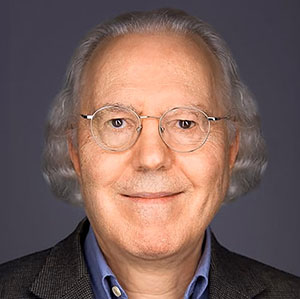
Don Armstrong, 74, spent 10 years on a “labor of love” to research and write The Life and Writings of Ralph J. Gleason, about the journalist who was described by the trumpeter Dizzy Gillespie as “America’s number one jazz writer,” when Gleason’s death was announced at the Monterey Jazz Festival in 1975.
Armstrong’s earlier work revitalizing Stuart’s downtown and saving one of its distinctive buildings could also be described as a labor of love. He was instrumental in bringing about the rebirth of the 1901 Stuart Feed Store building as the Stuart Heritage Museum — which marked its 33rd anniversary last year. He was also the first president of Stuart Heritage.
“I do not think it would have happened without Don,” historian and author Sandra Thurlow said of the museum, at 101 Flagler Ave. Attractions include a diorama of Stuart as it looked in 1896, with tiny replicas of the Florida East Coast railroad and downtown buildings, many of them long gone. The museum has collected thousands of historical documents as well as every high school year book in Stuart since 1926. Visitors come from all over — it’s open every day and charges no admission fee.
“A lady from New Zealand has been there,” Thurlow said, “People come in from Canada and, just the other day when I was there, from Argentina.”
Armstrong’s family moved to Stuart in 1925, the year that Martin County was created from portions of St. Lucie and Palm Beach counties. Gov. John D. Martin — for whom the county was named — appointed Armstrong’s uncle, E.J. Smith, as the first county judge that same year. Armstrong’s father, Don Sr., was also an architect, who designed most local schools built during the baby boom. He received a national award for his design of J.D. Parker Elementary School. He designed additions to St. Mary’s Episcopal Church, over the years,
and Don Jr. served as architect for more recent additions and renovations to the church. Don Jr.’s mother, Frances Armstrong, founded the church thrift shop, Mary’s Closet, in 1961.
Armstrong graduated from Martin County High School in 1969. While in high school he sang with a rock band called Children of the Night. In the ’70s, he sang and played lead guitar with a rock band called Refuge. He earned a master’s degree in architecture at the University of Florida in 1985. Back in Stuart, he worked on the early restoration of The Lyric Theatre and wrote The Lyric’s successful nomination to the National Register of Historic Places. He also designed the first Florida Oceanographic Society building.
He later moved to Alabama to teach architecture at Tuskegee University. His wife, Jessica, taught journalism at the University of Alabama. The couple moved back to Stuart in 2016 and live in a home in St. Lucie Estates beneath 125-year-old mango trees. The neighborhood used to be a mango plantation.
”This town will always be my home — a really special place,” he said. But he was shocked by some of the changes he saw downtown after his 20 year absence: new buildings that were out of scale and out of character.
“The city should resume enforcing the architectural codes written by Andres Duany and Elizabeth Plater-Zyberk [noted Miami-based architects], which the city adopted in the early 1990s,” he said. “The codes also need to be revised to limit building height to two stories, with retail space on the first floor. A preservation ordinance should protect historic buildings. The revised codes and the ordinance should cover a larger area.”
NEW SOUNDS

His book about Gleason, which Jessica edited, traces the journalist’s life from his childhood in Chappequa, N.Y., when he got the measles and his bedroom was shielded from sunlight to prevent blindness. He had a radio that kept him entertained with music, especially jazz — much of it by African-American musicians — which was a novelty for a boy in mostly white suburbia. Networks played the music of black jazzmen late at night when most people were asleep, because of pressure from advertisers — many of them Southern companies.
“Strange sounds to a white teenager living in a rural hamlet where only three African Americans resided,” Armstrong wrote.
Gleason got further acquainted with jazz when he enrolled at Columbia University in New York in 1934. The repeal of Prohibition had led to the opening of a string of jazz clubs on 52nd Street, while the Apollo Theatre in Harlem often featured Duke Ellington as a headliner. There was an antiwar mood among the student body. Many had grown up hearing about the horrors of World War I.
“Gleason enters a new world of jazz, activism and academics — a heady mileau for the Chappequa escapee, one that would reset his life perspective,” Armstrong wrote.
Perhaps remembering his early fascination with jazz, Gleason embraced teenagers’ passion for rock ’n’ roll in the ’50s and ’60s.
“For Gleason, rock ’n’ roll was the vernacular music of the new generation,” Armstrong writes. “He said there are two underground cultures in our society today that are particularly interesting, the Negro and the teenager. He called Chubby Checkers’s Pony Time, ‘one of the natural folk songs of high school Americans.’”
Gleason covered the music scene in California as a writer for the San Francisco Chronicle. It was the early ’60s, a time of political unrest and early opposition to the war in Vietnam. Baby boomers of a certain age might recall the Free Speech Movement that exploded at Berkeley in 1964. Gleason wrote about the role of songs in that movement. “Free speech on phonograph records and free speech in song,” he wrote. “The winds of change are blowing again.”
Armstrong’s narrative is encyclopedic in its descriptions of trends that Gleason wrote about, from “hot jazz” of the 1930s to “race records,” a term used by record producers for music that later became known as rhythm and blues. He covered every major pop singer of the day: from Sinatra and Elvis to the Beatles, Bob Dylan, Joan Baez, and many more. Besides writing syndicated columns, Gleason hosted radio programs and cofounded both the Monterey Jazz Festival and Rolling Stone magazine. Armstrong’s book was published by Bloomsbury Academic and is available on Amazon.
“It’s an important book that tells the history of 20th century America through its popular culture,” Thurlow said.
See the original article in print publication
Jan. 1, 2026