Hear the history of Florida in less than an hour
 Are you new to the area and want a primer on the history of Florida? Or maybe you’re an old-timer who wants to put some of the pieces of Florida’s history together.
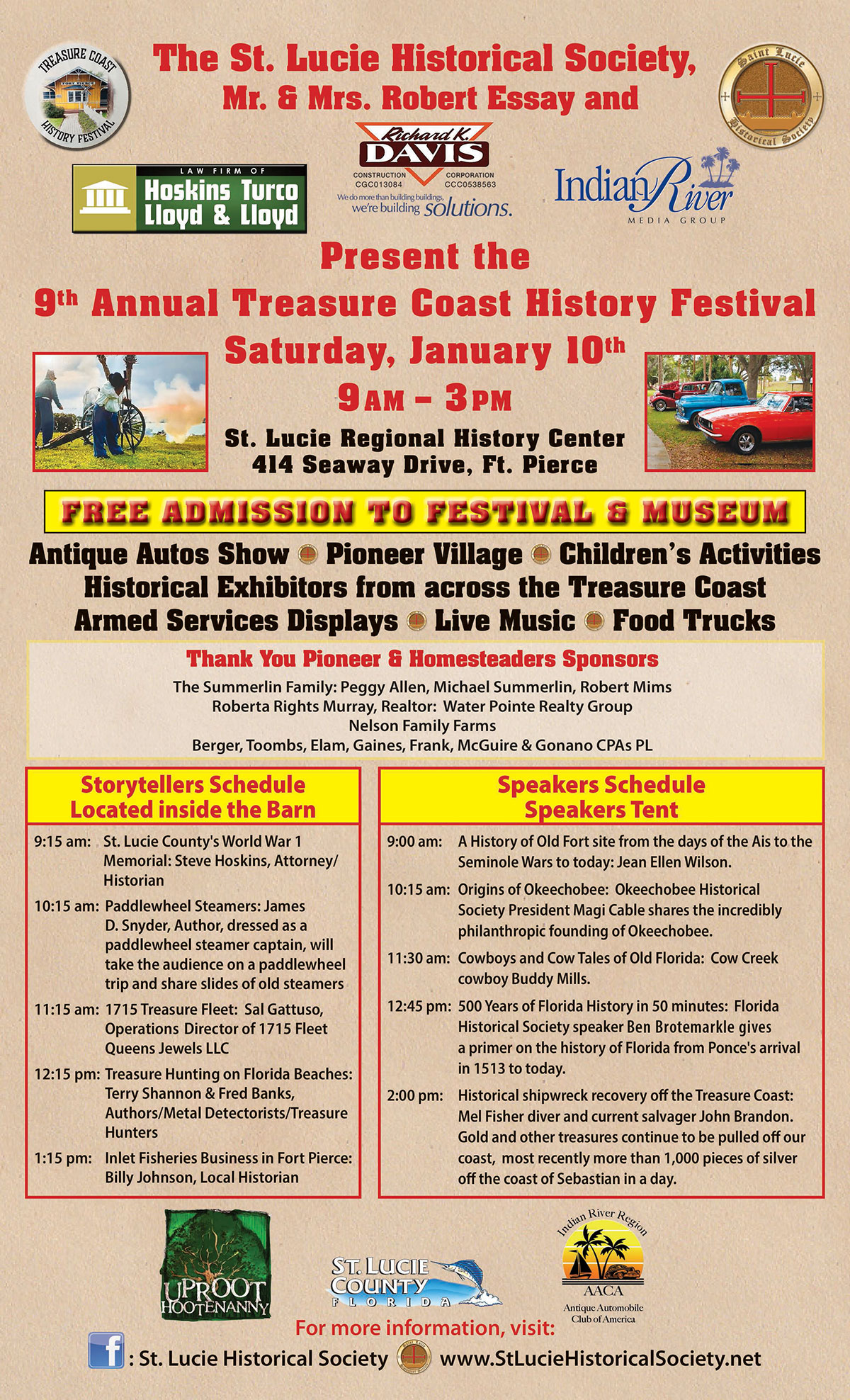
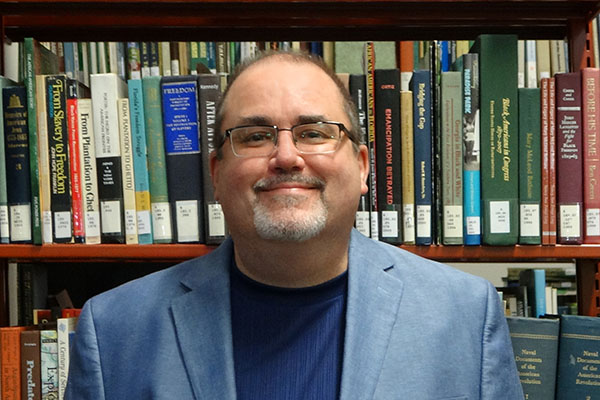
Everyone may find answers to their questions about Florida History when Dr. Ben Brotemarkle, executive director of the Florida Historical Society, delivers the keynote address, “The Complete History of Florida in Less than an Hour,’’ at the Ninth Annual Treasure Coast History Festival this Saturday. The free festival, which runs from 9 a.m. to 3 p.m., is at the grounds of the St. Lucie History Center, 414 Seaway Drive, Fort Pierce, and Brotemarkle’s talk is at 12:45 p.m.
Indian River Magazine/Space Coast Living Publisher Gregory Enns, founder of the festival, asked Brotemarkle to give a preview of his talk.
Your talk is titled “The Complete History of Florida in Less than an Hour.’’ Can the history of Florida really be conveyed in an hour?
The title of the presentation is meant to be a little joke because, of course, the complete history of the state can't be told in an hour, but many people believe that it can. Some people think it's basically "Ponce came in 1513, a few people moved here after the Civil War, then Disney came in the 1970s," and that's about it. While the title is said with a smile, what we can actually do in less than an hour is briefly describe every major period in our state's history, and describe some of the most interesting people and events that shaped those different aspects of our history, and contributed to our unique cultural heritage.
What will be the biggest takeaway for people attending your talk?
I think that a lot of people are surprised to learn that people have been living in Florida for 15,000 years, and that at the time of European contact in the 1500s, there were dozens of Native American groups throughout the state with complex societies, and sophisticated cultures. People are often surprised to learn that people of African descent were among the first non-indigenous people to set foot in Florida, that the first legally sanctioned black community was just north of St. Augustine, and that following the Civil War the first incorporated town governed entirely by African Americans was established near Orlando. Our state's diverse communities include Greeks in Tarpon Springs, Cubans in Maimi, and many more. I guess that the biggest takeaway is that our state has always been comprised of a rich tapestry of cultures that have contributed to our shared history.
Tell us the timespan your talk will cover.
We will take a whirlwind tour of Florida history and culture from prehistoric times to the present day!
Will your talk have visuals?
Yes, the presentation includes a comprehensive slide show with images that accentuate my talking points. The slides are all images, no text, so we can keep to our "less than an hour" deadline.
Tell us about your history or your family’s history in Florida.
My Dad was in the Air Force, so we moved all around when I was a kid. My older sister was born in Tampa, but the family was
briefly in New Jersey when I was born. With my job as Executive Director of the Florida Historical Society, I have often said how convenient it would have been if I was the one born here instead of my sister. My family vacationed in Florida, and we moved here in the late 1970s. I graduated from Winter Park High School where I met my future wife, Chris, and I have lived in the state ever since.
How did you become interested in Florida history?
I kind of came to history through the back door. Chris and I both attended the Florida School of the Arts in Palatka for our first couple of years of college, where I was a Voice Performance major. The school's interdisciplinary approach meant that I had to take Music History, Theater History, Dance History, Art History, and Humanities courses. I was fascinated at how much more a piece of music or work of art can be enjoyed when you understand the historical context in which it was created. In the summer of 1982, I was a featured cast member in "Cross and Sword," the official state play of Florida, that used to be presented in the St. Augustine Amphitheater every year. I played multiple roles including both Spanish and French soldiers, and I sang the French song that Don Pedro Menendez de Aviles listens to from a distance, before he slaughters the French settlers and establishes St. Augustine. I've been hooked on Florida history and culture ever since.
If you had to cite one fascinating thing about Florida history, what would it be?
That's a really difficult question, because I love so many different aspects of our state's amazing history. If I had to pick just one thing, it would probably be the incredible Windover Archaeological Dig. In 1982, a backhoe operator working to build the Windover Farms neighborhood near the intersection of state road 50 and I-95 in Titusville discovered ancient human remains that turned out to be between 7,000 and 8,000 years old, and changed the way we thought about prehistoric people. To hear the full story you have to come to my presentation.
Tell us what the Florida Historical Society does and what you do as executive director.
The Florida Historical Society was established in 1856, and is the oldest existing cultural organization in the state. FHS was first based in St. Augustine, but has moved around the state to locations including Jacksonville, Gainesville, and St. Petersburg. Since 1992, we have been proudly based in Brevard County, where we intend to stay. The Florida Historical Society Press just celebrated 100 years of publishing books in 2025, and we also publish our academic journal the Florida Historical Quarterly. Two of our most successful educational outreach projects are Florida Frontiers: The Weekly Radio Magazine of the Florida Historical Society which airs on NPR affiliates around the state, and our television series Florida Frontiers which airs on PBS affiliates. More than 600 episodes of our radio program and 66 episodes of our television show are archived on our website at myfloridahistory.org. We hold two annual conferences, the FHS Annual Meeting and Symposium each October at the University of Central Florida, and the FHS Public History Forum held in a different Florida city each May. We also have a presence at many events around the state including the Zora Neale Hurston Festival of the Arts and Humanities in Eatonville, the Florida Folk Festival in White Springs, the Miami Book Fair, and many others. We're looking forward to the Treasure Coast History Festival! As Executive Director of FHS I have my hand in all of the activities I just mentioned, and am responsible for finding funding to support all of that.
What do you think the strongest historical connections are between the Space Coast (Brevard County) and the Treasure Coast (St. Lucie, Martin and Indian River counties)
There are many strong historical connections between these areas. I mentioned the 8,000-year-old people of Windover discovered in Brevard County. Indian River County has the even older human remains initially known as Vero Man, but actually turned out to be a woman who lived about 12 thousand years ago. Spanish conquistadors sailed along these coasts and interacted with Native Americans here. The same sense of exploring unknown territories that the Spanish, French, and English must have felt in the Colonial Era continues today with America's space program which is largely based here. Of course, the cattlemen who brought their families here in the 1800s ran their cattle and settled in what are now the counties you mentioned.
Florida often seems left out of the national history narrative. Why do you think this is?
That is a complex question, but I think there are basically three reasons for that. First, before Florida was named a United States Territory in 1821, the area was claimed by the Spanish for the majority of that time, excluding a brief occupation by the French, and twenty years under British rule. Spanish-speaking Florida is excluded in the popular historical narrative. Second, the story of the 13 "original" British colonies that formed the foundation for the United States, ignores the fourteenth and fifteenth colonies of East Florida and West Florida, because they remained Loyalist strongholds during the American Revolution. Also, Florida was the third state to secede from the Union during the Civil War. After the war, historians who were mostly based in northern states, tended to "punish" Florida and the South by minimizing their importance in the historical narrative of our nation. We at the Florida Historical Society are actively working to correct that.